



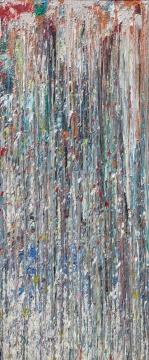
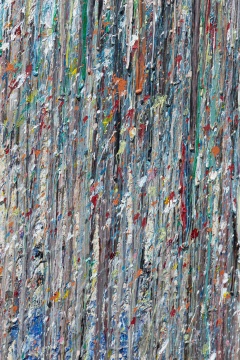
Larry Poons (American, b. Japan 1937) "Fiddle Stop"
Hammer Price w/ BP
$109,800
| Lot #: 12 Larry Poons (American, b. Japan 1937) "Fiddle Stop" |
|
Acrylic on canvas. Signed, titled, and dated '1976' on the reverse. Catalog Note: A similar example by Poons, titled "Blushing Prince" - 1976, acrylic on canvas, 89 x 53 inches (226.06 x 134.62 cm) Collection Buffalo AKG Art Museum. Gift of Kenneth C. Griffin, 2019. Purchased by the Albright-Knox Art Gallery with funds provided by Kenneth C. Griffin, January 17, 2019. Contemporary Art Day - 10 May 2012, New York. Provenance: Yares Art, New York; purchased by the Albright-Knox Art Gallery with funds provided by Kenneth C. Griffin, January 17, 2019. |
| 106 x 44 in. |
|
Provenance Nina Freudenheim Gallery, Buffalo. Acquired by the present owner from the above. |
|
Auction Date Sep 25, 2025 |
Details:
During Poons’s exhibitions at Freudenheim’s gallery, his work was critically reviewed in prominent publications like Artforum and Art in America. These reviews often praised his ability to combine color and texture in new and exciting ways, and critics were especially drawn to the material nature of his paintings.
The gallery’s role in exhibiting Poons in this context was crucial for broadening his visibility. As art critics and curators took notice, Poons’s work began to resonate not just in New York but also in international art circles. Larry Poons has always been something of a maverick who trusts his instincts and never minds fashion. He first became known in the early 1960s for stripped down "dot" paintings whose combination of evenly stained color, punctuated with small precise lozenges, aligned him with Color Field, Minimalism and Op Art in one fell swoop. By the late 1960s, he had gone heavy-duty, creating thick, creviced topographies of paint poured on horizontal unstretched canvases soon designated the "Elephant Skin" series.
By 1971, the canvas was back on the wall, and Mr. Poons was throwing paint from cans and buckets, always aiming high. It ran down the surface in thick rivulets as funkily literal as they are associational. Words like vines, rain, waterfalls and fountains run through the mind in this rare and wonderful show, titled "Ruffles Queequeg + The Throw Decade 1971-1981." (The reference to Queequeg of "Moby Dick" fame is a transitional wavelike work.) I can imagine these pieces holding their own against Monet’s "Waterlilies." In an essay in the catalog, Frank Stella, the painter and Mr. Poons’s friend, calls him "Mr. Natural," which seems accurate.
Larry Poons (American, b. 1937)
Larry Poons, born October 1, 1937 in Tokyo, Japan, is an abstract artist who began painting in 1959 and continues apace today. Though he originally rose to fame for his Op Art paintings of the 1960s – with monochrome canvases replete with staccato marks that draw the eye across the surface in a frenetic dance – Poons’ practice has shifted through various aesthetic modes, most recently in a loose, painterly style akin to abstract expressionism or lyrical abstraction.
Poons studied at the School of the Museum of Fine Arts in Boston and the Art Students League of New York in the early 1960s. In 1965, MoMA curator William Seitz included Poons in “The Responsive Eye” along with Josef Albers, Larry Bell, Ellsworth Kelly, and Ad Reinhardt. In 1969, Poons was the youngest artist to participate in "New York Painting and Sculpture, 1940-1970,” curated by Henry Geldzahler at the Metropolitan Museum of Art. Other artists included in the landmark survey were Hans Hoffman, Jackson Pollock, Willem de Kooning, and Jules Olitsky.
Poons now lives and works in New York, returning to the League in 1997 where he continues to teach.
Shipping Information:
Unlike many auction companies, Cottone Auctions offers a full-service shipping department. We’re equipped to pack and safely ship just about any item to just about any location around the globe.
Learn more >
