



Milton Avery (American, 1885-1965) Sleeping Baby
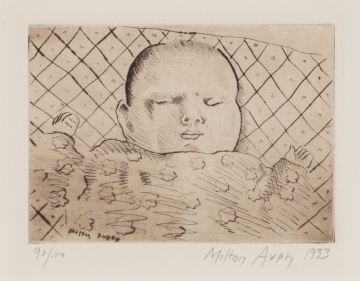
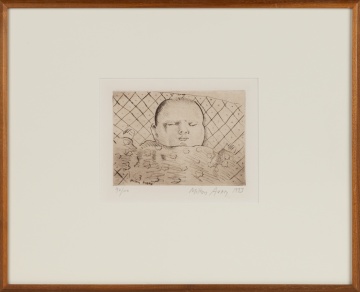
| Lot #: 94 Milton Avery (American, 1885-1965) Sleeping Baby |
|
1933. Drypoint. Signed '92/100 Milton Avery 1933'. Sheet: 10 x 11 1/2 in. |
| 5 1/4 x 7 1/2 in. |
|
Condition Excellent. |
|
Auction Date Nov 20, 2025 |
| Estimate: $300-$500 |
Details:
Milton Avery (American, 1885-1965)
Milton Avery was a pioneering American modernist known for his intimate portraits, serene landscapes, and still lifes characterized by simplified forms and luminous planes of color. Born in Altmar, New York, and largely self-taught, he worked a series of factory jobs in Connecticut while studying art in Hartford before moving to New York City in 1925, where his wife, artist Sally Michel Avery, supported their household as he refined his distinctive voice.
Inspired by American Impressionism and the bold chromatic innovations of Henri Matisse, Avery increasingly distilled his subjects into harmonious shapes and subtle hues, seeking – as he famously stated – “unique relationships” of color and form independent of detail. He became a key mentor and influence to younger painters including Mark Rothko, Adolph Gottlieb, and Barnett Newman, helping pave the way for future American Color Field and Abstract movements.
Though initially overlooked, his career turned a corner in 1929 when the Phillips Collection in Washington, D.C., became the first museum to acquire his work, followed by important exhibitions at the Phillips and the Whitney Museum that solidified his reputation. Today, Avery’s quiet yet groundbreaking contributions to American art are celebrated in major museum collections worldwide, from MoMA and the National Gallery of Art to Tate and LACMA.
Milton Avery was a pioneering American modernist known for his intimate portraits, serene landscapes, and still lifes characterized by simplified forms and luminous planes of color. Born in Altmar, New York, and largely self-taught, he worked a series of factory jobs in Connecticut while studying art in Hartford before moving to New York City in 1925, where his wife, artist Sally Michel Avery, supported their household as he refined his distinctive voice.
Inspired by American Impressionism and the bold chromatic innovations of Henri Matisse, Avery increasingly distilled his subjects into harmonious shapes and subtle hues, seeking – as he famously stated – “unique relationships” of color and form independent of detail. He became a key mentor and influence to younger painters including Mark Rothko, Adolph Gottlieb, and Barnett Newman, helping pave the way for future American Color Field and Abstract movements.
Though initially overlooked, his career turned a corner in 1929 when the Phillips Collection in Washington, D.C., became the first museum to acquire his work, followed by important exhibitions at the Phillips and the Whitney Museum that solidified his reputation. Today, Avery’s quiet yet groundbreaking contributions to American art are celebrated in major museum collections worldwide, from MoMA and the National Gallery of Art to Tate and LACMA.
Shipping Information:
Unlike many auction companies, Cottone Auctions offers a full-service shipping department. We’re equipped to pack and safely ship just about any item to just about any location around the globe.
Learn more >
