



Fernand Leger (French, 1881-1955) "Visage aux Deux Mains" (Face with Two Hands)
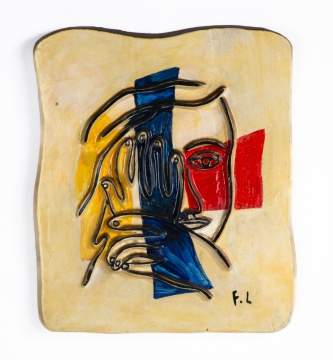
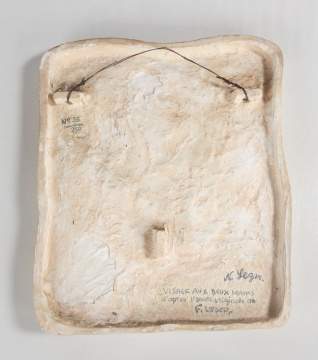
| Lot #: 13 Fernand Leger (French, 1881-1955) "Visage aux Deux Mains" (Face with Two Hands) |
|
1954. Terracotta low relief ceramic plaque. White clay with orange, yellow, blue, red, and black glazed enamel. Signed edition 35/250. |
| 18 x 15 in. |
|
Provenance Musee Fernand Leger, Biot, Alpes-Maritimes. Henry and Lilly Sieger Collection, New York. Thence by descent. |
|
Auction Date Mar 19, 2026 |
| Estimate: $3,000-$5,000 |
Details:
Fernand Leger (French, 1881-1955)
Fernand Leger was a pioneering French painter, sculptor, and filmmaker whose innovative approach to Cubism emphasized bold color, tubular forms, and the integration of machinery and human figures. Born in Argentan, France, Leger trained as an architectural draftsman before studying at the Academie Julian and the Ecole des Arts Decoratifs in Paris, where he absorbed the influences of Paul Cezanne, Pablo Picasso, and Georges Braque.
By the 1910s, he developed his signature style – often called Tubism – rendering objects and figures as volumetric cylinders and tubes, and creating socially conscious works such as Verdun, The Trench Diggers (1916) after his experience in World War I. Over a career spanning more than five decades, Leger worked across painting, mural design, ceramics, printmaking, theater, and film, including his avant-garde Ballet Mecanique (1924), and he co-founded the Academie de l’Art Moderne with Amedee Ozenfant.
Later in life, he relocated to New York during World War II, teaching and influencing the emerging generation of Abstract Expressionists, before returning to France in 1946 to continue his vibrant exploration of color, form, and everyday life, producing works that celebrated modern laborers and urban experience. His art is held in major collections worldwide, including MoMA, the Art Institute of Chicago, Tate, the Centre Pompidou, and the Albertina.
Fernand Leger was a pioneering French painter, sculptor, and filmmaker whose innovative approach to Cubism emphasized bold color, tubular forms, and the integration of machinery and human figures. Born in Argentan, France, Leger trained as an architectural draftsman before studying at the Academie Julian and the Ecole des Arts Decoratifs in Paris, where he absorbed the influences of Paul Cezanne, Pablo Picasso, and Georges Braque.
By the 1910s, he developed his signature style – often called Tubism – rendering objects and figures as volumetric cylinders and tubes, and creating socially conscious works such as Verdun, The Trench Diggers (1916) after his experience in World War I. Over a career spanning more than five decades, Leger worked across painting, mural design, ceramics, printmaking, theater, and film, including his avant-garde Ballet Mecanique (1924), and he co-founded the Academie de l’Art Moderne with Amedee Ozenfant.
Later in life, he relocated to New York during World War II, teaching and influencing the emerging generation of Abstract Expressionists, before returning to France in 1946 to continue his vibrant exploration of color, form, and everyday life, producing works that celebrated modern laborers and urban experience. His art is held in major collections worldwide, including MoMA, the Art Institute of Chicago, Tate, the Centre Pompidou, and the Albertina.
Shipping Information:
Unlike many auction companies, Cottone Auctions offers a full-service shipping department. We’re equipped to pack and safely ship just about any item to just about any location around the globe.
Learn more >
