



Alexander Oscar Levy (American, 1881-1947) Women Sewing
Hammer Price w/ BP
$32,940
| Lot #: 35 Alexander Oscar Levy (American, 1881-1947) Women Sewing |
|
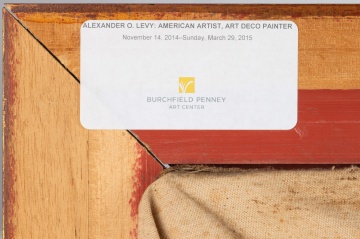
First quarter of the 20th century. Oil on canvas. Exhibited: Burchfield Penny Art Gallery ‘Alexander O. Levy: American Artist, Art Deco Painter’ from Nov 14, 2014 - Mar 29, 2015. |
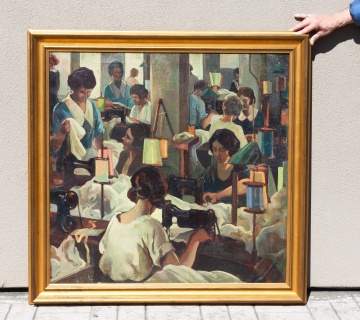
| 35 x 36 in. Framed: 41 x 42 1/2 in. |
|
Provenance The collection of Carl Slone (1944-2026), Buffalo, New York. |
|
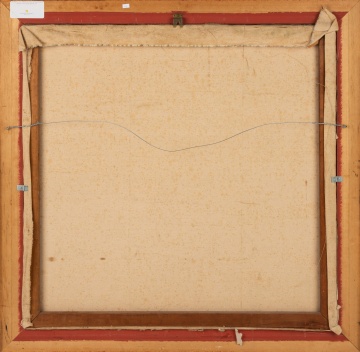
Condition Relined. |
|
Auction Date May 21, 2026 |
Details:
Note: Among the most socially engaged canvases of Levy's mature career, Sewing depicts a workroom of women garment workers - most plausibly a Works Progress Administration sewing room at the height of the federal program's operation, or possibly a Larkin Company workroom drawn from the artist's long association with the Buffalo mail-order conglomerate, where he served as art director from 1913 to 1925. Either reading places the painting at the heart of Buffalo's industrial and civic life in the interwar decades.
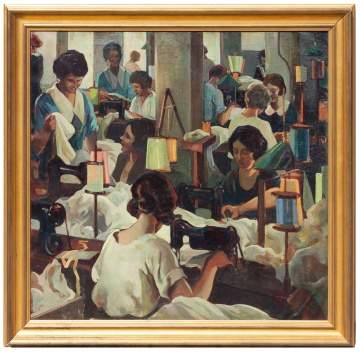
More than a dozen workers bend over rows of treadle-powered machines amid the voluminous white fabric of bedding, linens, and garments. Task lamps in jewel-toned shades of orange, green, blue, and rose punctuate the muted palette - a signature Levy gesture, transforming utilitarian objects into vehicles of color and rhythm. The composition unfolds in deep, receding planes beneath tall factory windows, the women ranging visibly in age and bearing across a heterogeneous workforce.
At 40 x 40 inches, Sewing matches the format Levy reserved throughout his career for his major figural statements, including The Rhumba Dancer (1934) and Womanhood Glorified (1923). That he chose to render a workroom of laboring women on the same monumental scale he reserved for society portraits and allegorical subjects is the painting's quiet argument: these workers, it insists, are worthy of the serious figural treatment American art had historically extended only to the privileged.
The result joins a current of late-1930s American Scene painting - alongside Elizabeth Olds and Mabel Dwight - that sought to dignify the labor of working women, while exceeding most contemporary treatments in scale and ambition. It stands as both a document of Buffalo's industrial moment and the fullest realization of Levy's enduring concerns: women as substantive subjects, the dignity of ordinary working people, and the orchestration of complex figural compositions brought into singular, ambitious union.
Alexander Oscar Levy (American, 1881-1947)
Born in Bonn, Germany, Alexander Oscar Levy emigrated to Cincinnati at the age of three and trained at the Cincinnati Art Academy under Frank Duveneck before continuing his studies at the New York School of Fine and Applied Art with William Merritt Chase, Robert Henri, and Ossip Linde. In 1909, he settled in Buffalo, New York, where he would remain for the rest of his life, serving as art director of the Larkin Company from 1913 to 1925 while contributing illustrations to The Saturday Evening Post, Saint Nicholas Magazine, and The Century.
Levy emerged as one of the few American painters working in a sustained Art Deco idiom, producing society portraits, allegorical figural compositions, market scenes, and brooding landscapes distinguished by a decorative use of color and a formal seriousness extended equally to imperious matrons and laboring women. The New York critic Peyton Boswell praised him as "a fantasist, expressing visions that originate in his brain and are free of natural encumbrances."
His work was exhibited at the Art Institute of Chicago, the Pennsylvania Academy of the Fine Arts, the Boston Museum of Fine Arts, and the Albright Art Gallery, and entered the permanent collections of the Cincinnati Art Museum, the Detroit Institute of Arts, the Brooklyn Museum, the Toledo Museum of Art, and the Denver Art Museum, among others. A staunch traditionalist whose public opposition to modernism placed him outside the prevailing currents of mid-century American art, Levy was the subject of a major retrospective, Alexander O. Levy: American Artist, Art Deco Painter, at the Burchfield Penney Art Center, Buffalo, in 2014-2015, which has anchored a sustained reappraisal of his reputation.
More than a dozen workers bend over rows of treadle-powered machines amid the voluminous white fabric of bedding, linens, and garments. Task lamps in jewel-toned shades of orange, green, blue, and rose punctuate the muted palette - a signature Levy gesture, transforming utilitarian objects into vehicles of color and rhythm. The composition unfolds in deep, receding planes beneath tall factory windows, the women ranging visibly in age and bearing across a heterogeneous workforce.
At 40 x 40 inches, Sewing matches the format Levy reserved throughout his career for his major figural statements, including The Rhumba Dancer (1934) and Womanhood Glorified (1923). That he chose to render a workroom of laboring women on the same monumental scale he reserved for society portraits and allegorical subjects is the painting's quiet argument: these workers, it insists, are worthy of the serious figural treatment American art had historically extended only to the privileged.
The result joins a current of late-1930s American Scene painting - alongside Elizabeth Olds and Mabel Dwight - that sought to dignify the labor of working women, while exceeding most contemporary treatments in scale and ambition. It stands as both a document of Buffalo's industrial moment and the fullest realization of Levy's enduring concerns: women as substantive subjects, the dignity of ordinary working people, and the orchestration of complex figural compositions brought into singular, ambitious union.
Alexander Oscar Levy (American, 1881-1947)
Born in Bonn, Germany, Alexander Oscar Levy emigrated to Cincinnati at the age of three and trained at the Cincinnati Art Academy under Frank Duveneck before continuing his studies at the New York School of Fine and Applied Art with William Merritt Chase, Robert Henri, and Ossip Linde. In 1909, he settled in Buffalo, New York, where he would remain for the rest of his life, serving as art director of the Larkin Company from 1913 to 1925 while contributing illustrations to The Saturday Evening Post, Saint Nicholas Magazine, and The Century.
Levy emerged as one of the few American painters working in a sustained Art Deco idiom, producing society portraits, allegorical figural compositions, market scenes, and brooding landscapes distinguished by a decorative use of color and a formal seriousness extended equally to imperious matrons and laboring women. The New York critic Peyton Boswell praised him as "a fantasist, expressing visions that originate in his brain and are free of natural encumbrances."
His work was exhibited at the Art Institute of Chicago, the Pennsylvania Academy of the Fine Arts, the Boston Museum of Fine Arts, and the Albright Art Gallery, and entered the permanent collections of the Cincinnati Art Museum, the Detroit Institute of Arts, the Brooklyn Museum, the Toledo Museum of Art, and the Denver Art Museum, among others. A staunch traditionalist whose public opposition to modernism placed him outside the prevailing currents of mid-century American art, Levy was the subject of a major retrospective, Alexander O. Levy: American Artist, Art Deco Painter, at the Burchfield Penney Art Center, Buffalo, in 2014-2015, which has anchored a sustained reappraisal of his reputation.
Shipping Information:
Unlike many auction companies, Cottone Auctions offers a full-service shipping department. We’re equipped to pack and safely ship just about any item to just about any location around the globe.
Learn more >
