



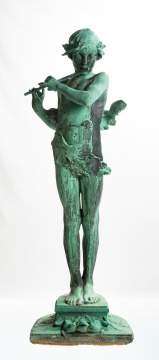
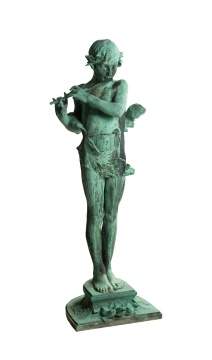
Edward F. McCartan (American, 1879-1947) "Pan"
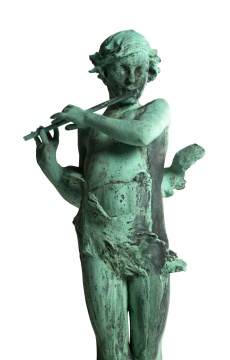
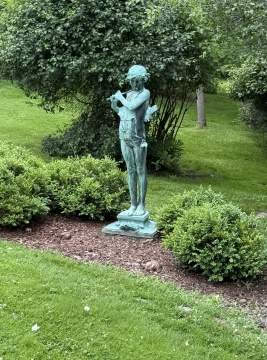
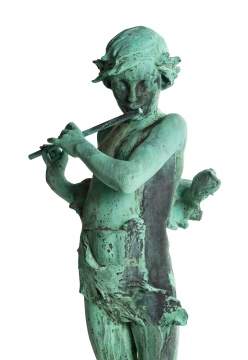
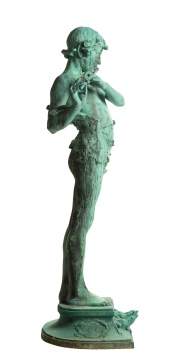
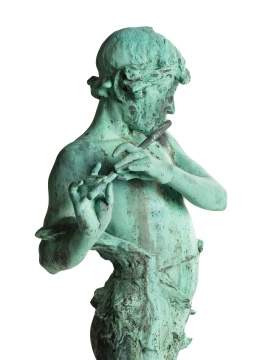
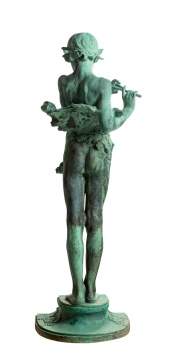
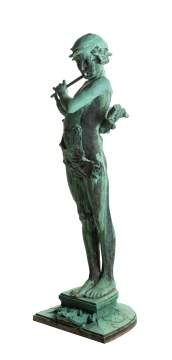
| Lot #: 356 Edward F. McCartan (American, 1879-1947) "Pan" |
|
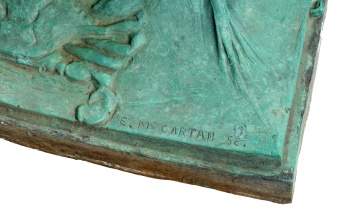
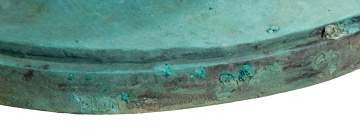
Modeled circa 1913. Cast by the Gorham Company Founders circa 1913-1916. Bronze with green patina. Incised 'E. McCARTAN Sc.' to the upper surface of the base at the left and stamped 'GORHAM CO. FOUNDERS', with a small foundry cartouche, to the edge of the base. Exhibited: |
| Ht. 56 in. (Life-Size / Estate Garden Fountain) |
|
Provenance The Buffalo Fine Arts Academy (Albright Art Gallery), Buffalo, New York. John D. Larkin (1845–1926), Buffalo, New York, for the gardens of “Larkland,” 107 Lincoln Parkway, Buffalo. By descent to his daughter, Ruth Read Larkin Robb (1891–1975), and her husband, Walter B. Robb (1886–1959), Buffalo, New York. Thence by descent within the family to The estate of Patricia Forman Robb, Buffalo, New York. |
|
Condition The deep, weathered green patina is the natural record of more than a century of display out of doors, exactly as McCartan intended his Pan to be seen. |
|
Auction Date Sep 24, 2026 |
| Estimate: $20,000-$40,000 |
Details:
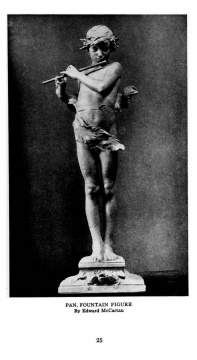
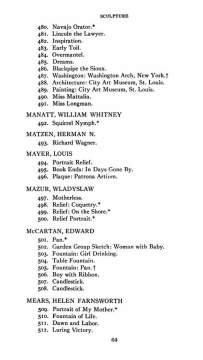
Catalogue of an Exhibition of Contemporary American Sculpture, Held Under the Auspices of the National Sculpture Society, exh. cat., Buffalo, Albright Art Gallery, 1916, no. 501 and no. 505, the present cast illustrated as a full-page plate (“PAN, FOUNTAIN FIGURE / By Edward McCartan”) (for the model and the artist).
R. Cortissoz, “The Field of Art: The Sculpture of Edward McCartan,” Scribner’s Magazine [vol./date to be supplied].
B.G. Proske, Brookgreen Gardens Sculpture, Brookgreen, South Carolina, 1968 (for the artist).
J. Conner and J. Rosenkranz, Rediscoveries in American Sculpture: Studio Works, 1893–1939, Austin, Texas, 1989 (for the artist and the model).
T. Tolles, ed., American Sculpture in the Metropolitan Museum of Art, Volume II, New York, 2001 (for the artist).
National Academy of Design, New York, object no. 78-S (Young Pan), curatorial record (for the model, the edition, and the artist’s 1922 correspondence).
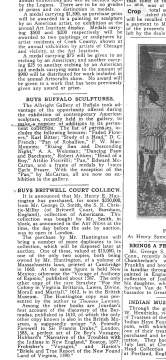
American Art News, Vol. 15, No. 6 - Saturday, November 11, 1916, page 3, under the headline "Buys Buffalo Sculptures."
Catalog Note:
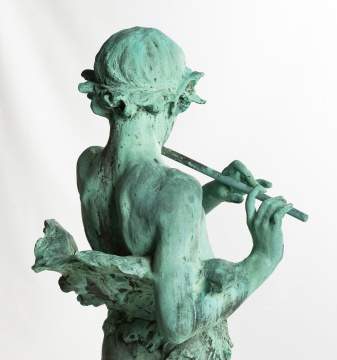
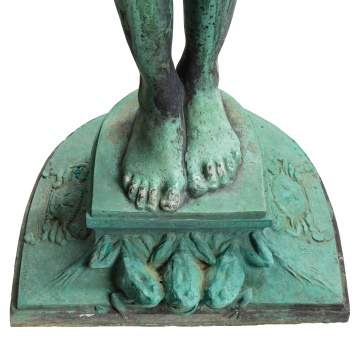
Modeled about 1913, shortly after McCartan’s return from four years of study in Paris under Jean-Antoine Injalbert, Pan is among the most accomplished garden bronzes of the American Beaux-Arts movement and the work with which the sculptor first established his independent reputation. A nude boy crowned with a wreath lifts a single pipe to his lips, his head tilted and his shoulders given a subtle contrapposto twist; three frogs gather at his feet along the front edge of the base, the conceit that identifies the figure as a fountain. The composition pays graceful homage to Frederick MacMonnies’s celebrated Pan of Rohallion (1890) - itself shown in the 1916 Buffalo exhibition - while announcing the lithe elegance and refined surfaces, indebted to Houdon and the French eighteenth century, that would culminate in McCartan’s masterpiece, the Diana of 1920-23.
McCartan conceived Pan on a grand scale, completing the present 56-inch life-size version in 1913 for the garden of a home in Westchester County, New York. The first cast of the model was acquired by the financier Felix M. Warburg, who lent it to the National Academy of Design’s Winter Exhibition of 1913 (no. 44); the early literature records the Warburg bronze as “the first copy,” and the figure may indeed have been conceived with the Warburg garden in mind. The sculptor later reduced the design to a version of just over thirty inches and to a small table fountain, but it was in its grand original size that Pan made its most celebrated public appearances: a cast was shown at the Panama-Pacific International Exposition in San Francisco in 1915, and the life-size figure was exhibited at the Metropolitan Museum of Art’s Exhibition of American Sculpture in 1918. In a letter of 1922 to Cornelia Bentley Sage Quinton, director of the Albright Art Gallery, McCartan stated that the edition of Pan had been limited to six casts across all sizes - a number that places the present life-size example among the rarest of the sculptor’s garden works.
The present bronze is the cast exhibited - and photographed for the catalogue - at the landmark Exhibition of Contemporary American Sculpture mounted by the National Sculpture Society at the Albright Art Gallery, Buffalo, from June to October 1916, where it presided out of doors among the forty largest fountain figures set upon the terraces and the lawns of Delaware Park. It entered the collection of the Buffalo Fine Arts Academy and passed to John D. Larkin (1845-1926), the founder of the Larkin Soap Company and one of Buffalo’s foremost industrialists and civic patrons, who served as a Director of the Academy in the very year of the exhibition. Larkin’s baronial estate, “Larkland,” occupied an entire block bordering Delaware Park within sight of the gallery, its grounds laid out with gardens, terraces, and greenhouses ideally suited to a bronze of this scale and subject. The sculpture passed to Larkin’s youngest daughter, Ruth Read Larkin, who in 1915 married the Larkin Company executive Walter B. Robb, and it has remained with their descendants ever since. The deep, weathered green patina is the natural record of more than a century of display out of doors, exactly as McCartan intended his Pan to be seen.
Shipping Information:
Unlike many auction companies, Cottone Auctions offers a full-service shipping department. We’re equipped to pack and safely ship just about any item to just about any location around the globe.
Learn more >
